
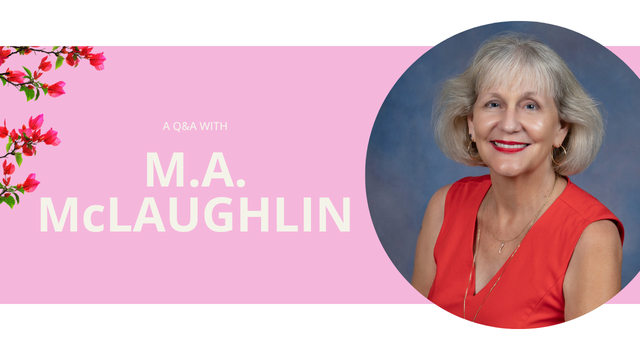
A Q&A WITH M.A. MCLAUGHLIN
If you could describe The Secret Diary of Rome in three words, what would they be?
‘Buried secrets revealed’
What drew you to Lizzie Siddal and the Pre-Raphaelite world?
My fascination with the pre-Raphaelites began when I was a teenager, and my mother gifted me with Christina Rosetti’s poem, ‘Goblin Market.’ It had a kind of gothic lyricism that intrigued me, especially because I wanted to be a poet then. That work triggered my fascination with the entire Rosetti family — their art, their poetry, their Bohemian lives — including Dante Gabriel’s muse, Lizzie Siddal. I was surprised to discover later that she was a painter and poet in her own right. Over the years, I always wanted to include Lizzie in one of my books, but I never seemed to find the right project until The Secret Diary of Rome. It’s been a joy to spend time with the pre-Raphaelites while I was writing over the last year.
What do you love most about Emilia as a character, and what do you hope readers connect with in her?
I love Emilia’s fearlessness. She is determined to find out the truth about her deceased mother’s secrets, even at the risk of her future happiness. It’s easier to tiptoe around the things that families prefer to conceal, but Emilia refuses to take that route. I hope readers connect with that quality, along with her ability to accept eventually that mothers and daughters can have complicated relationships and still love each other. Forgiveness is what allows Emilia to move on with her life.
What do you enjoy most about writing a mystery that unfolds across dual-timelines?
I enjoy writing dual-timelines because they seem to fit my personality. Part of me feels very nineteenth-century with my love of Romantic and Victorian literature, and part of me is much more contemporary in my tastes and lifestyle. Blending these two time periods also gives me the opportunity to show how connected the present is with the past — especially in Italy where every place has such a rich history. I found Rome to be particularly interesting as a setting because it’s a city that’s literally layered with one era after another, somehow all blending together. No one lives in isolation. We’re always going to be influenced by what came before us.
If you could own one object from your book — the antique music box, a rare book or a Rossetti painting — which would you choose and why?
As a writer and booklover, I would definitely want to own Lizzie’s diary. It’s fictional, but her whole life is contained in the pages of that little book — her hopes, her dreams, and her disappointments. Very poignant. And actual diaries are so personal — a private window into a person’s life, and I find them irresistible. They are one of my favourite types of secondary research for my novels because there is always a line or phrase that seems to pop out like a beacon, drawing me into the ‘emotional centre’ of how to turn a historical figure into a character.